How to Export Gmail Emails to a Hard Drive: 5 Clear Methods


Blog Overview: Yes, users export Gmail emails to a hard drive and keep secured local copy of their mailbox outside Google account. There is no single best method. Best method for you depends on what you want. Whether you want to save one email, move an entire mailbox, preserve emails as PDF, or create controlled backup.

Select the Right Gmail Export Method
Users do not need same method for every situation. Saving one important email is different from backing up years of Gmail messages. You do not need same method for every situation. Saving one important email is different from creating a backup of years of Gmail messages.
| What you need | Best Option | Why |
|---|---|---|
| Save 1 to 10 Emails | Download message | Quick and simple. |
| Keeping email as readable document. | Save as PDF | Easy to share and open. |
| Export Large Gmail Mailbox | Google Takeout | Free and developed for bulk data export. |
| Working with emails in Outlook | PST-based export | Convenient for outlook users. |
| Filter, automate or export in multiple formats. | Dedicated Backup tool | More control over backup. |
Quick Answer – To export Gmail emails to hard drive, simplest and free choice is Google Takeout. Gmail’s own facility. Gmail’s built-in download and PDF options are better for individual messages. Dedicated tool becomes useful when user need more control over formats, filters, attachments and local backup.
Method 1: Use Google Takeout for Full Gmail Export
Google Takeout is Google’s official service for exporting data from Gmail and other Google products. It is practical free method when you want a large amount of Gmail data in one export.
Step 1: Open Google Takeout
- Sign in to the Google account that have Gmail messages you want to export.
- Open Google Takeout, (takeout.google.com)
Step 2: Select Gmail Mail
- Click Deselect all.
- Select Mail with Gmail icon.
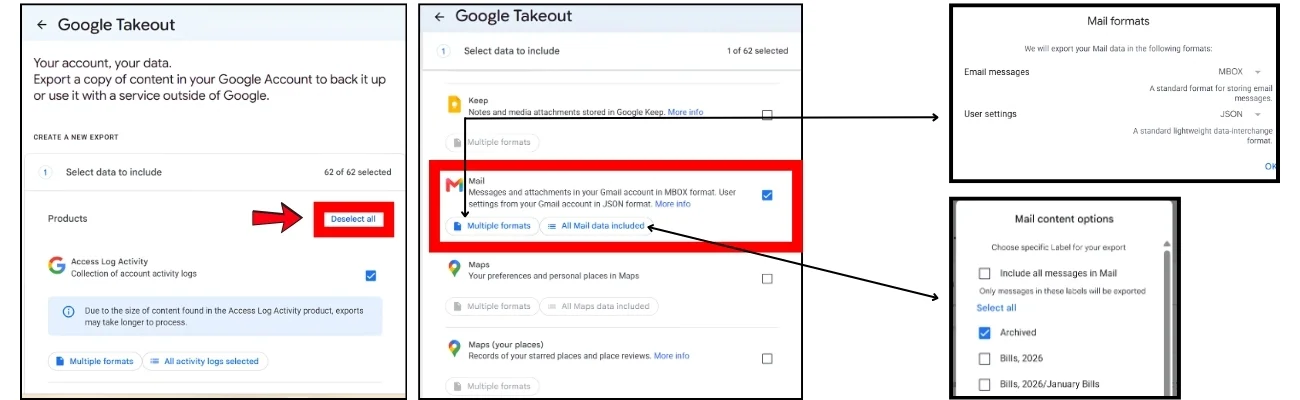
Google’s Gmail icon will show you two small buttons. If you demand a full inbox do not touch them. If you demand only specific folders like inbox, sent than manage this.
Step 3: Create and Download Archive
- Select Destination as download link via email
- Set the frequency and size as per your inbox and your requirements.
- Click create export. Once export is done you will receive a download link in your Gmail inbox.
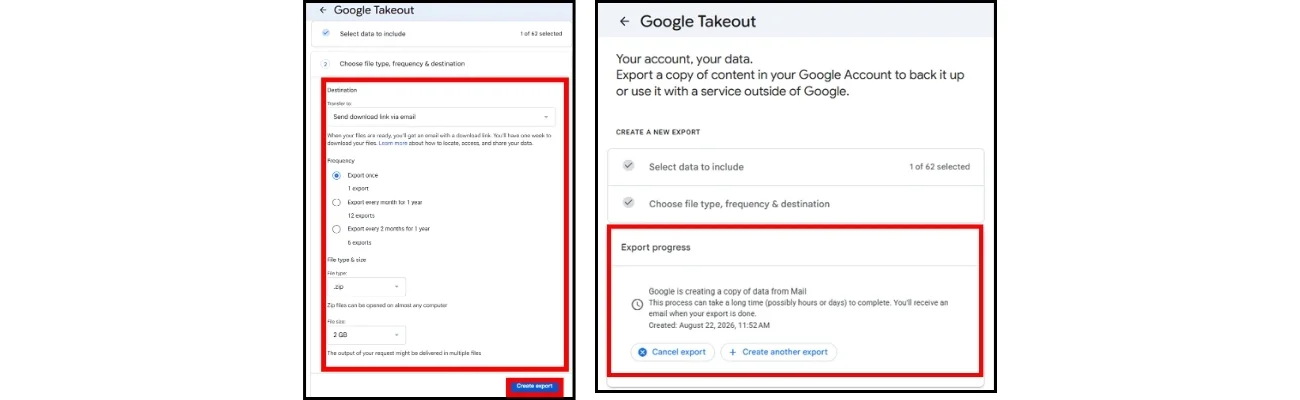
When Google finishes preparing the export, download archive to your computer. You can then move or copy that downloaded file to your hard drive or external storage.
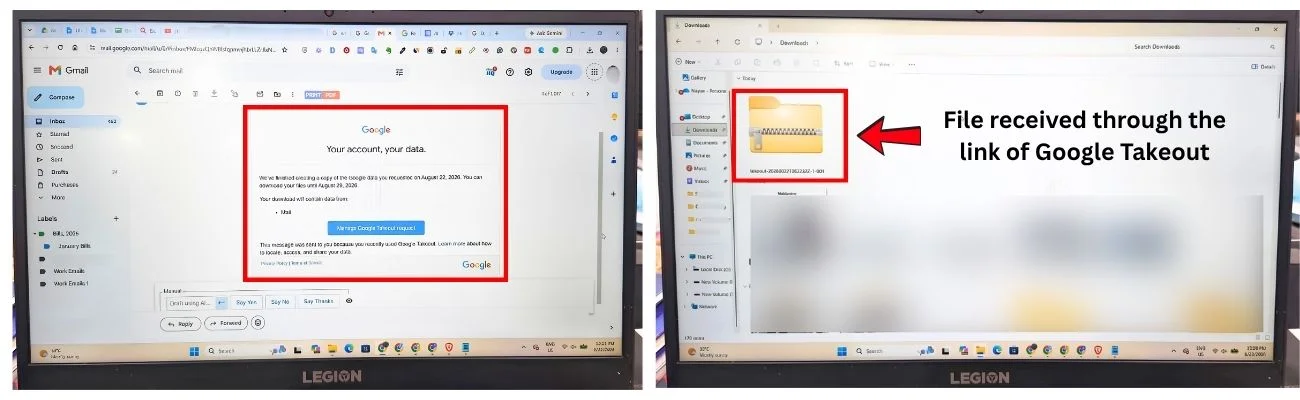
What You Get From Google Takeout
Important part comes after download. Your Gmail data is packaged into an archive rather than folder containing readable email files. Gmail exports contain mail in MBOX format. Think of MBOX as large storage box. Instead of keeping every email in separate file, many messages can be kept together inside one mailbox file. To know more about MBOX you can visit our guide on Gmail to MBOX, where you can dig deeper into it.
Does Google Takeout Include Attachments?
Yes. Google’s current Gmail export documentation mentioned that download can include Message content:
- Headers
- Attachments,
- Different types of Gmail labels and settings.
That makes Takeout useful when user goal is to preserve broad copy of your Gmail mailbox rather than saving only the visible text of individual messages.
Where to Store the Export?
Keep downloaded archive on storage with enough free space. If you have larger mailboxes, an external HDD or SSD can be practical rather than using computer’s internal storage alone. Always keep a second copy when information is important. Single hard drive can fail or be lost.
Method 2: Download Individual Gmail Emails
If you only need few important messages, full mailbox export may be unnecessary. Gmail provides a built-in option to download an individual message.
- Open the email,
- Click on three-dot menu on top right.
- Choose Download message.
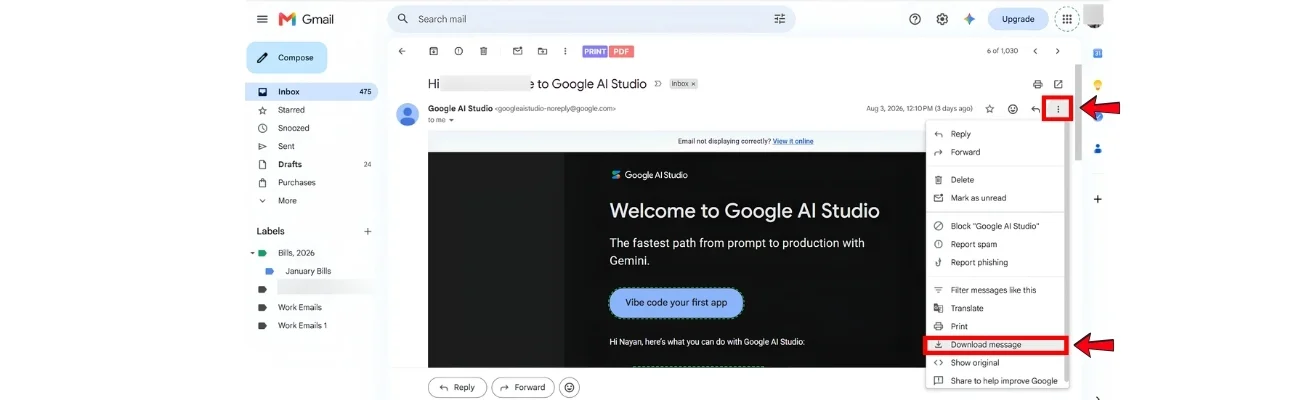 This is useful when you want a specific email saved locally without creating a large mailbox archive.
Method 3: Save Gmail Emails as PDF
PDF is useful when your goal is to preserve an email as a document that is easy to open, read, print, or share.
- Open email in Gmail.
- Choose the Print option,
- Select Save as PDF in print dialogue box.
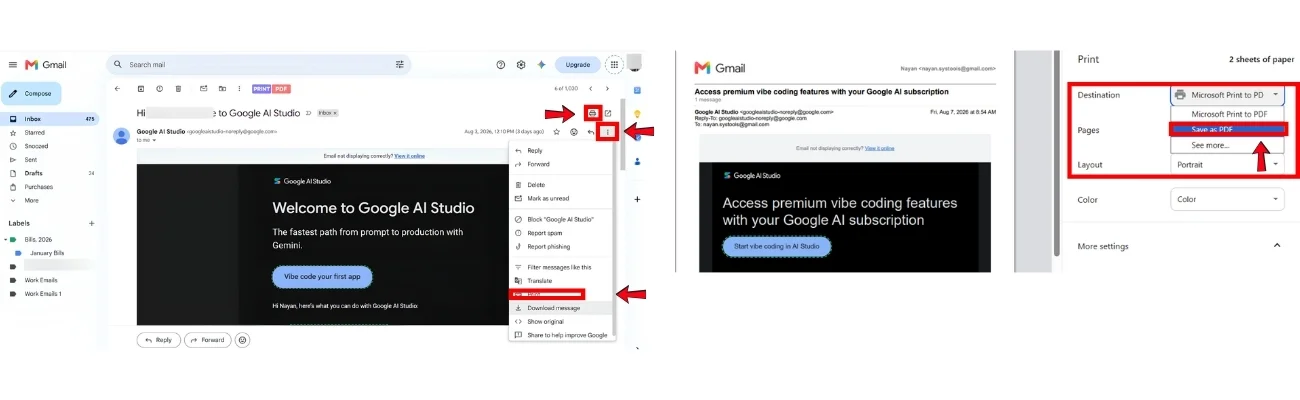
- Select your drive hard or external storage as destination.
Important distinction is that PDF is a document copy, not a full mailbox backup. For detailed guide on this method, see How to Save Gmail Email to PDF File.
Method 4: Export Gmail Emails Through Outlook
Many users prefer to work with Gmail messages through Microsoft Outlook. This route can make sense when Outlook is already part of your workflow and you need mailbox data in Outlook-friendly environment. The disadvantage is it adds another application to the process. You also need to consider how the messages are stored and exported through Outlook.
For users who only need to simply export Gmail emails to a hard drive. Google Takeout is easier. For users already working inside an Outlook-centered workflow, PST may be more practical. Let us check how users can save Gmail emails to a Hard Drive using dedicated tool.
Method 5: Use Gmail Backup Software for More Control
Manual methods are very useful, but they become less convenient when requirement of user is more specific. For example, user want to:
- Back up selected Gmail folders and labels.
- Export emails within specific date range.
- Save emails in PST, MBOX, EML, MSG, or PDF.
- Preserve attachments and mailbox information accurately.
- Back up Gmail data and Google Drive data together.
- Repeat backup later without downloading everything again.
To do all this dedicated Gmail email backup tool is designed for these situations. This is the point where dedicated tool can be useful than basic export workflow: you get more control over:
- What is backed up
- How it is saved,
- Where resulting files go.
Now let us check how to operate dedicated tool.
- Download and install the tool.
- Gmail will be auto-selected as source. Select your desired platform as destination.
- Select Email as your workload station.

- Decide date range if you want to save Gmail emails to a hard drive of any specific period.

- Sign in to your Gmail account securely via OAuth 2.0 Authentication.

- Finalize a folder in your connected hard drive in which you want to save backed up data.

- Start the backup process.

Which Method Fits Your Situation
Easiest way to choose is to start with your desired goal.
- Saving single important email – Download the message.
- Want clean copy you can easily read or print – Save it as PDF.
- Require broad Gmail export for free – Use Google Takeout.
- Already work with Outlook – Consider an Outlook/PST workflow.
- Need filters, multiple output formats, repeatable backups, or Gmail and Google Drive together – Use dedicated backup solution.
What Happens After Export?
Getting the Gmail data into your hard drive is only one step. Users should also know what they have downloaded and whether the format matches your next goal.
- If you used Google Takeout, you will get an MBOX-based archive.
- If you saved an individual email, you have a separate message file.
- Used PDF, you have a document for reading and sharing.
Right format depends on what users plan to do next. For long-term preservation, think about where local copy is stored, whether you have another backup, and how easily you can access the information years later.
For more guidance on keeping Gmail messages safe for the long term, read Preserve Emails in Gmail Securely.
Export vs Backup vs Archive
These words sound familiar, but they describe different things.
- Export means creating copy of your data outside Gmail.
- Backup means keeping copy so data can be used later.
- Archive in Gmail means removing message from Inbox via but keeping it inside your Gmail account.
If user goal is to keep independent copy on hard drive, archiving Gmail message is not the same as backing it up locally. We hope you have got some clarity on how to export Gmail emails to hard drive.
Wrapping Up
There is no single export method that is best for everyone. Every method is perfect for a different situation. If users need a full and free export Google Takeout is ultimate. On the other hand goal is to download only few emails, download option is good. For readable records, PDF is simplest choice and for advanced backup needs, dedicated tool provides greater control over formats, filtering and local storage.
Frequently Asked Question
A: By using Google Takeout you can save Gmail messages in MBOX format only. Whereas the expert software allows you to save in PST, EML, MSG & MBOX formats.
A: Yes, the software allows you to save all attachments from each email.
A: Google Takeout will takeout too much time to create an archive and then download data. It is recommended to use a professional tool mentioned in the blog, which is much faster.
A: Yes, the expert tool allows you to pause and resume the process, whenever you want.