Backup Thunderbird Email To Hard Drive: 100% Proven Methods


Quick Answer: To backup Thunderbird email to external hard drive quickly, copy your Thunderbird profile folder. To do so,
- Close the Thunderbird desktop application.
- Press Win + R >> type %APPDATA%\Thunderbird\Profiles\ >> hit Enter
- Find the folder with default-release.
- Copy the entire folder and paste it to the desired local storage, external hard drive, or USB flash drive. Or sync it to cloud storage.
And, to backup Thunderbird emails in bulk or migrate to Outlook securely, use Freeviewer Ultimate Converter. It will export and backup Thunderbird emails smoothly without any issues.
Seeking a precise answer to: How to backup Thunderbird emails to external hard drive? If yes, then you must be:
- Upgrading or restructuring your system
- Creating a recovery backup against data loss
- Or moving to a new email client (such as Outlook)
For every scenario, having a solid Thunderbird Mail backup strategy is the key to achieving desired outcomes. Otherwise, a simple, routine email backup can turn into an unexpected nightmare costing you years of critical data.
Luckily, you can easily bypass this catastrophic instance. Simply by following the Thunderbird email backup methods shared in this detailed guide. It shares everything –from basic manual methods to the best free tool to backup Thunderbird emails without losing folders.
So, go through this thorough write-up, especially designed for Thunderbird users. And learn how to move Thunderbird data, emails, and contacts to a new computer. Including fixing common export errors and an ultimate security solution for professionals to secure your data forever.
Does Thunderbird Automatically Backup My Emails?
No, Thunderbird doesn’t backup your emails automatically or feature an auto-backup system. As a Thunderbird Mail user, you have to backup Thunderbird emails to external hard drive manually. To do so, you can either copy your profile folder or use a professional IMAP backup tool. Also, this clearly states that your data can be lost -highlighting the urgency of Thunderbird email backup.
Importance of Backing Up Thunderbird Email to Hard Drive
Users might think that Mozilla Thunderbird does not require backup because its data is saved in the system. This idea is not correct at all. In the case of hacking or a system crash, Thunderbird emails will become unrecoverable. Saving Thunderbird mailbox files to an external hard drive is important for a number of reasons. Some of these are:
- Enhanced Performance: After copying the Thunderbird emails to local storage, one can delete the data from the server. When the local server has less space occupied, the performance of the server improves significantly.
- Protection From Hacking: Hackers can cause users trouble if they get access to their Thunderbird emails. But with a backup, you can prevent permanent loss of data.
- Uninterrupted Business: Local server failure hampers any business that does not have data backup. A saved copy of Thunderbird emails helps organizations to continue their regular business process.
- Safeguarding Against Data Loss: Thunderbird email data backup safeguards your data from all types of accidents. In case you unintentionally delete some emails, these can be recovered from the backup file.
- Effortless Data Migration: If Thunderbird emails are saved on a hard drive, it is easy to transfer them. When users need to export Thunderbird data to another system, this backup turns out to be very useful.
Where Does Thunderbird Store Emails?
Knowing where Thunderbird stores your emails is the first step to ensure a successful Thunderbird mail backup to external hard drive. Because most users believe that Thunderbird stores email in its program files. But it keeps all your local emails, passwords, extensions, and settings in a single directory: Profile Folder.
And that brings us to one of the most asked queries on the IT forums: “Where does Thunderbird store emails on Windows 10/11?” or “Where is the Thunderbird profile folder located in Windows 11?
- In Windows 10/11, your profile folder is typically stored in C:\Users\<YourUsername>\AppData\Roaming\Thunderbird\Profiles\. You can also type %APPDATA%\Thunderbird\Profiles\ in the Run dialog box (Win + R) to locate the profile folder.
- Mac users can find their profile folder within the macOS Library. To access, open Finder >> click Go >> Go to Folder >> type ~/Library/Thunderbird/ Profiles/
- Linux users have to access their home directory as it is hidden there. To do so, Press Ctrl + H >> go to ~/.thunderbird/.
People Also Explored: Resolve Thunderbird Not Displaying Message Content Issue: DIY!
How to Backup Thunderbird Emails? 4 Proven Methods
“Hello, I need to know the procedure to back up all my emails from Thunderbird profile to an external hard drive or cloud storage. I am currently using an up-to-date version of Windows 10 on an HP computer. The Thunderbird edition is 60.3.3. Also, the mailbox size is quite large, so please suggest a reliable solution. “
Due to the defined reasons, it is important to backup Thunderbird emails to external hard drive. So, here are the four best and most-used Thunderbird email backup methods:
Method #1: The Manual Profile Copy (Industry-Standard)
When it comes to backing up Thunderbird emails to a hard drive error-free, the Manual Profile Copy method is the industry standard. It gives users complete control over the Thunderbird email backup.
Key Advantages:
- It can easily handle 50GB+ profiles without failing.
- It captures the profiles.ini mapping file that eliminates the need of manual profile manager.
- It allows safely extracting large, auto-regenerating files (such as a SQLite search database) before performing Thunderbird email backup.
Step #1: Open Thunderbird and Compact Folders
- Open Thunderbird.
- Select File >> click Compact Folders. (or click on the account in the sidebar and select Compact). This permanently removes the already deleted emails to prevent them from backing up.
- Wait for the status bar at the bottom to complete.
Step #2: Find the Data Using the Menu
- Move to Help >> Troubleshooting Information. (Or click the three-line menu, Help >> More >> Troubleshooting Information).
Step #3: Open the Specific Folder
- Find the Application Basics section
- Look for the Profile Folder row >> click the button next to it:
- Windows 11: Open Folder
- Mac: Show in Finder
- Linux: Open Directory
- It will open the file manager directly inside the profile folder.
Step #4: Close Thunderbird Completely
- Keep the file manager window running. But shut down the Thunderbird app completely.
Note: Do not copy active databases to prevent a corrupted backup.
Step #5: Move Up to the Root Directory
- In the file manager, look for the main Thunderbird folder (go up in the root directory tree).
- Find the folder that includes the Profiles folder and the profiles.ini file.
- Windows: Go up to C:\Users\[YourName]\AppData\Roaming\
- Mac: Go up to ~/Library/
- Linux: Go up to ~/ (Home) to see the hidden .thunderbird folder.
Step #6: Delete the Search Index (Before Copying)
- Open the profile folder again.
- Search for global-messages-db.sqlite >> delete it.
- Once deleted, go back to the root folder.
Step #7: Copy & Paste the Entire Root Folder
- Select the Thunderbird folder. (Or .thunderbird on Linux).
- Click Copy the complete root folder.
- Lastly, paste the entire folder into the external hard drive, USB drive, or cloud storage directory.
Method #2: The Built-In Export Tool
The built-in export tool is the second-best method to backup Thunderbird emails – introduced in Thunderbird version 102. It automatically combines your complete profile into a .zip file. This includes:
- Emails: Entire locally saved messages (IMAP caches and POP3 archives).
- Configuration: Account settings, server details, and personalized signatures.
- Identity Data: Address books and calendar entries.
- Security: Passwords (If Saved) and security certifications.
- Customizations: Installed Add-ons and layout preferences.
So, before you begin the steps, confirm that you have enough free space on your computer or external drive. Because the new Thunderbird email backup file will be roughly the same size as your active Thunderbird profile.
Steps to perform Thunderbird email backup (using the built-in Export tool)
- Go to File and select Compact Folders.
- Wait until the status bar (at the bottom left) completes.
- Click the Tools menu (at the top of the screen). Or click the three horizontal lines for the Application Menu) >> select Export.
- Review the estimated size of the backup displayed in the “Export Your Profile” tab. It will help you ensure the destination drive has enough capacity.
- Click the Export button.
- Choose the destination for the backup (In the standard file explorer window) >> click Save.
Note: You can change the default file name Thunderbird_profile_backup.zip as per your preference.
- Lastly, Thunderbird will automatically shut itself down. Simply wait till the progress bar fills. Once it’s done, the window disappears, and the backup is completed.
While this native tool handles the complex background work, it also has some limitations that you shouldn’t overlook -especially if you have a massive email history.
Troubleshooting Common Errors:
#1: 2GB Limit (Older Systems)
|
Problem |
Solution |
|
|
Related Reads: Fix Error Thunderbird Inbox is Full & Can’t Hold More Messages
#2: Search Database Bloat
|
Problem |
Solution |
|
|
#3: No Selective Backups
|
Problem |
Solution |
|
|
Method 3: Copy the Thunderbird Appdata Roaming Folder to USB
How to copy the Thunderbird Appdata Roaming folder to USB? Here’s how:
- Exit Mozilla Thunderbird if it is open. Suppose the profile folder is zzzzzzzz.default
- Locate the profile folder at this location:
User > AppData > Roaming > Mozilla Thunderbird> zzzzzzzz.default - Right-click this folder and select the Copy option
- Go to the saving location, like a CDRW disk, USB, etc. Right-click and paste to save the copied Thunderbird profile folder.
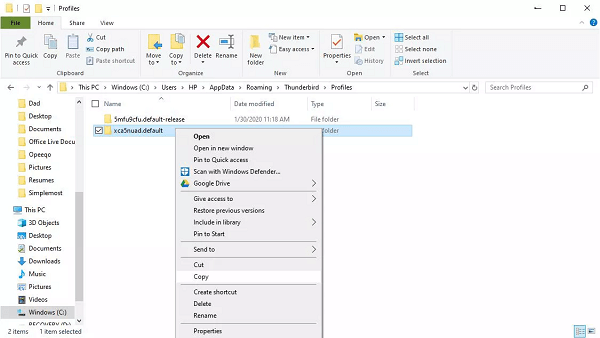
Restore Backup Profile: To restore the backup profile manually, simply replace the Thunderbird profile folder with the copied one on the same system or new computer as per requirements. Thus, users can access the backed up data in Thunderbird any time they need it.
Method #4: ImportExportTools NG Add-On
How do I save multiple Thunderbird emails as PDF or EML files?
- Run Thunderbird and install the ImportExportTools NG add-on in it.
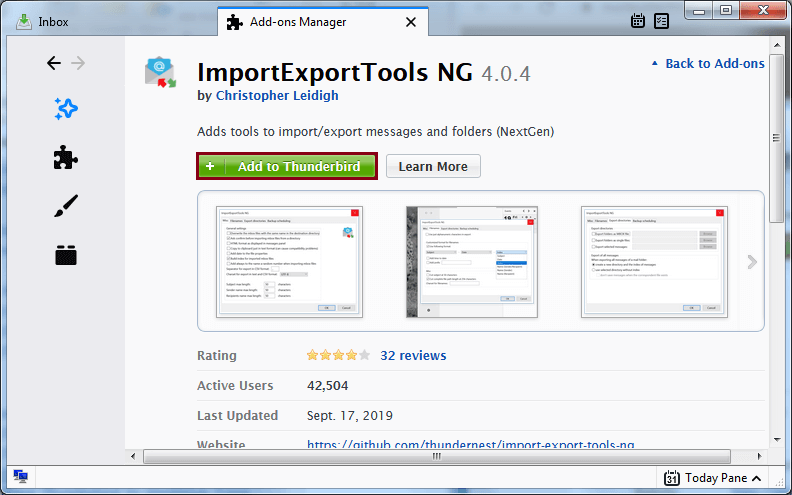
- Once the add-on is installed, restart Thunderbird.
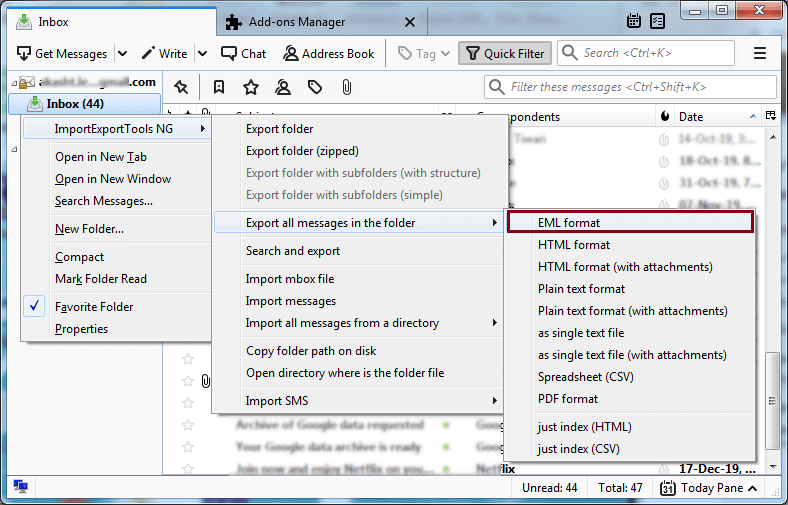
- Now, choose a folder you want to back up (such as Inbox) and right-click on it.
- Select ImportExportTools NG, then Export folder, then EML format to backup Thunderbird emails on the hard drive in EML format.
- Choose a location to save the files and click Select Folder.
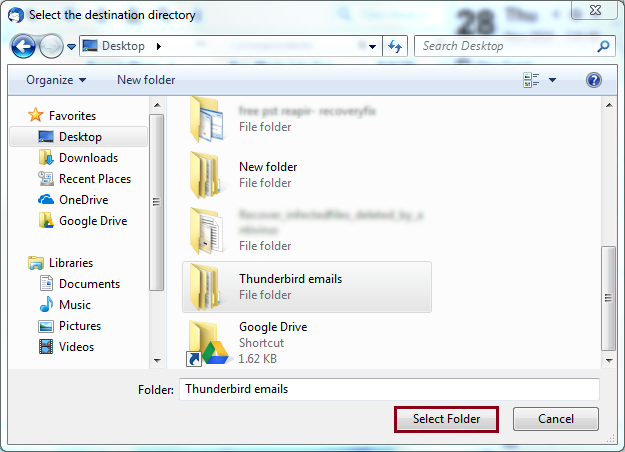
Now all the emails are saved as a backup on your hard disk. These files can be directly opened in Mozilla Thunderbird at any later date.
But how to fix the Thunderbird export tool zip file too large error?
The “Zip file too large” error is a common issue that occurs when the backup feature in ImportExport NG is used to export Thunderbird emails. This happens because the standard ZIP libraries cannot support files over 4GB.
However, you can easily fix this issue. Simply export the individual folders as raw MBOX files instead of a ZIP file.
How to Restore and Migrate Thunderbird Emails?
Do you know most of the users experience friction when restoring Thunderbird email data? It is because after a sudden hard drive failure or setting up a new workspace, the restoration process requires precision.
So, without any further delays, let’s check out how to move Thunderbird from an old computer to a new one without losing contacts:
Method #1: The Replacement Method
The replacement method is the standard method to restore the Thunderbird mail backup to an external hard drive or on a new computer (with the same operating system). Users have to replace the newly generated profile with their backed-up profile to restore the Thunderbird backup.
Steps to restore Thunderbird backup (via the Replacement Method):
- Open Mozilla Thunderbird on the new computer.
- Let the setup screen load and close it once it’s loaded. It prompts Thunderbird to create a fresh & empty profile directory.
- Insert the external hard drive or USB flash drive (into the new computer). Make sure the old profile folder is saved in it.
- Find the new profile (Press Win + R >> type %APPDATA%\Thunderbird\Profiles\ >> hit Enter).
- Open the new folder (e.g., x8y9z012.default-release) >> delete all contents.
- Open the backed-up (default-release) folder >> copy & paste all the contents into the newly generated (empty) folder. Make sure all the contents are moved (including the prefs.js file, Mail folder, ImapMail folder, etc).
- Lastly, restart Thunderbird.
Method #2: The Profile Manager Method
The profile manager method is typically used when Thunderbird doesn’t count the pasted files in the new profile folder. It often occurs when the profiles.ini file (the file Thunderbird uses to locate the data) is missing, corrupted, or pointed towards the wrong directory during a Thunderbird profile migration.
This restoration method skips the common bugs linked with the standard drag-and-drop method. And promises a flawless Thunderbird backup and restore.
Use the Profile Manager:
- When copy-paste restoration fails
- When storing the active Thunderbird profile on the alternate drive instead of the default C:\ drive
- When moving across different operating systems (such as Windows to macOS).
Steps to use the Profile Manager (to restore backup)
- First, confirm that Thunderbird is completely closed.
- Next:
- Windows 11/Windows 10: Press Win+R >> Type thunderbird.exe -P >> Press Enter.
- macOS: Open the Terminal app (Press Command + Space >> type Terminal) and paste the given command >> hit Return button:
/Applications/Thunderbird.app/Contents/MacOS/thunderbird-bin -P - Ubuntu/Linux: Launch Terminal (Press Ctrl + Alt + T) >> Type thunderbird -P >> Press Enter.
- Ensure the backed-up profile folder is stored securely on the computer.
- Select the Create Profile button (in the Profile Manager).
- Click Next (in the pop-up wizard) >> Name the profile.
- Click the Choose Folder button. It will trigger a file explorer window.
- Select the exact location of the backed-up profile folder.
Note: Make sure not to select the parent folder. Only select the specific profile folder containing prefs.js and Mail folders.
- Click the Finish button. Doing this will redirect you to the main profile manager window.
- Finally, check whether the newly named profile is mentioned in the list. Check the “Use the selected profile without asking at startup” >> click Start Thunderbird.
Pro-Tip: You might experience Thunderbird app crashes on startup or missing emails even after successfully linking the backed-up profile. This happens due to corrupted, underlying MBOX files.
To bypass this error, drop the native restoration method and use the Freeviewer advanced converter tool. Using it, you can easily extract the data of the broken folder in an accessible format.
Method #3: Migrating Data to a Different Email Client
Importing a Thunderbird profile to a different email client (such as Microsoft Outlook or Exchange) to migrate emails simply doesn’t work! This is because Thunderbird keeps emails in MBOX format (without file extensions), which Microsoft does not support natively. Resulting in the manual copying process failing.
To bypass this, you must convert your complete MBOX files into an accepted file format by the respective email client. This can be time-consuming and error-prone. To deal with such intense scenarios, experts strongly recommend third-party software.
Also Check Out: Migrate Thunderbird to Google Workspace Quickly without Data Loss
Limitations of Manual Method
Users should keep in mind the limitations of performing the backup process manually. Some of its drawbacks are:
- Time-Taking Process: The manual method to back up Thunderbird emails is time-consuming. The complete process takes a considerable amount of time and effort.
- Multiple Steps: This method contains multiple steps. Users have to be alert to perform all steps sequentially.
- Supervision Needed: The technique cannot be processed unsupervised. Users have to actively administer the entire process.
- File Formats: The manual methods often bind you to simple formats. You cannot backup your data in major formats such as PST, MSG, PDF (with attachments), etc.
The above-mentioned drawbacks lead many users to perform Thunderbird email backup using an automated method.
The Ultimate Solution for Professionals (Freeviewer)
Users can apply an automated method to avoid the drawbacks of the manual method. Using third-party applications to restore Thunderbird data by an automated MBOX to Outlook Converter is a reliable tool to back up Thunderbird email to external hard drive. It might not be wrong to say that this professional software is a definitive answer to: How do I save multiple Thunderbird emails as PDF or EML files?
It provides a one-stop solution to Thunderbird backup problems. Users can preview all Thunderbird emails using this software. It can save the mailbox in several file formats:
- EML (Use for restoring in Thunderbird)
- PST, MSG (Use for restoring in Outlook)
- PDF (for secure backup and legal issues)
- HTML (for viewing emails in a browser)
- NSF (Use to restore in IBM Notes)
This program can also detect MBOX data even without an appended extension. Windows and Mac users can effortlessly use this software on their systems. This program automatically performs backup so that users do not need to supervise continuously.
Conclusion
This post describes the methods to backup Thunderbird email to external hard drive in a seamless manner. Users can choose the manual method, but it has some limitations.
Therefore, an automated method is also suggested. Users can use either of the given techniques to perform the task without losing attributes.
Freeviewer Suggests:
- Finally! Got the Solution to Import PST to Thunderbird Application
- Move Thunderbird Profile to New Computer in Windows 11, 10, 8, 7
- Top 4 Solutions to Fix Unable to Open Attachments in Thunderbird
- How to Convert Thunderbird Emails to CSV: Ultimate Guide
- How to Batch Print Thunderbird Emails to PDF With Attachments?
FAQS (Frequently Asked Questions)
Q.1 Does Thunderbird automatically backup my emails?
Unfortunately, Thunderbird doesn’t backup emails automatically or provide a native auto-backup feature. It stores data only to the local drive, which increases the risk of data loss if your drive corrupts. So, it is strongly advised to keep a manual backup.
Q.2 How do I restore my Thunderbird profile on a new computer?
- Open Mozilla Thunderbird on the new computer.
- Cancel the set up new email account prompt.
- Close Thunderbird to create default profile files and folder structure.
- Press Win + R >> type %appdata% >> go to \Thunderbird\Profiles\.
- Wipe out all the contents inside the new profile folder.
- Copy and paste all the contents from the old-backed-up profile folder.
- Re-launch Thunderbird.
Q.3 Can I backup Thunderbird to Google Drive automatically?
Absolutely, Yes! To do so,
- Open Thunderbird >> Help >> Troubleshooting Information.
- Find Profile Folder >> Open Folder >> copy the file path ( %APPDATA% \Thunderbird\Profiles\ ).
- Install Google Drive for Desktop.
- Move the Thunderbird profile folder into the Google Drive directory.
- Leave Google Drive running to auto-sync changes (in the background).
Q.4 How do I backup my Thunderbird emails to an external hard drive?
- Launch Thunderbird >> click the menu icon (in the top-right corner).
- Click Help >> Choose Troubleshooting Information.
- Scroll down to Profile Folder >> press the Open Folder button.
- Close Thunderbird completely.
- In the new window prompt, scroll up to the main Thunderbird folder.
- Insert the external hard drive into the computer.
- Lastly, copy the complete Thunderbird profile folder >> paste it onto the external hard drive.
Q.5 How to save all my Thunderbird emails before formatting my PC?
To ensure all Thunderbird emails are saved securely, must back up the complete Roaming Thunderbird folder. Also, to keep your account settings intact, the prefs.js file and all subfolders are necessary. You can also use the Freeviewer Advanced Thunderbird Backup tool. Because it guarantees a clean, consolidated archive file that can be easily used on any new OS.
Q.6 Can I just use the archive feature instead of backing up?
No, you cannot replace the archive feature with backing up. This is because the archive feature hides or moves items from the main view. It means if your hard drive gets corrupted, both the inbox and Archive folders will be lost permanently. In a nutshell, archiving mailbox data is not a true backup.
Q.7 How to archive Mozilla Thunderbird messages?
Follow the given easy steps to use Thunderbird’s native Archive feature:
- Go to the Account Settings.
- Move to “Copies & Folders”.
- Configure the given Archive Options as per your preference.