Why Are Mobile Devices Critical to a Digital Forensics Investigation?


Quick Answer: Mobile devices are critical to a digital forensics investigation because they contain something: no computer, camera, and paper trail contains: that is minute-by-minute record of:
- Where person went
- Who they talked to.
- What they did.
All this information in one pocket-sized little rectangle device. This is not a sales pitch. It is just what a phone is built to do. Think about your own phone. It knows:
- What time you woke up.
- Who you texted or WhatsApped at 2 AM.
- Coffee shop you walked into on Tuesday.
GPS logged it even if you meant it to or not. Now imagine that same phone belongs to suspect, a victim, or a witness. This is the reason investigators don’t start with a laptop anymore. They start with a phone.
What is Hiding Inside a Phone
Let’s get one thing clear before anything else: what is digital forensics, really?
Digital forensics is the process of pulling information off an electronic device without breaking it, and doing it in a way that judge can trust. That is it. Same idea if the device is a laptop, server, or a phone.
Cell phone forensics is that same science, for mobile devices. Here is the part that surprises people: Mobile forensics is now the busiest branch of the whole field. This is the reason users ask why are mobile devices critical to a digital forensics investigation.
Why The Shift Happened
Twenty years before, investigations started with desktop or filing cabinet. Today it begins with phone, and reason is almost simple: your phone is with you every single moment computer never was.
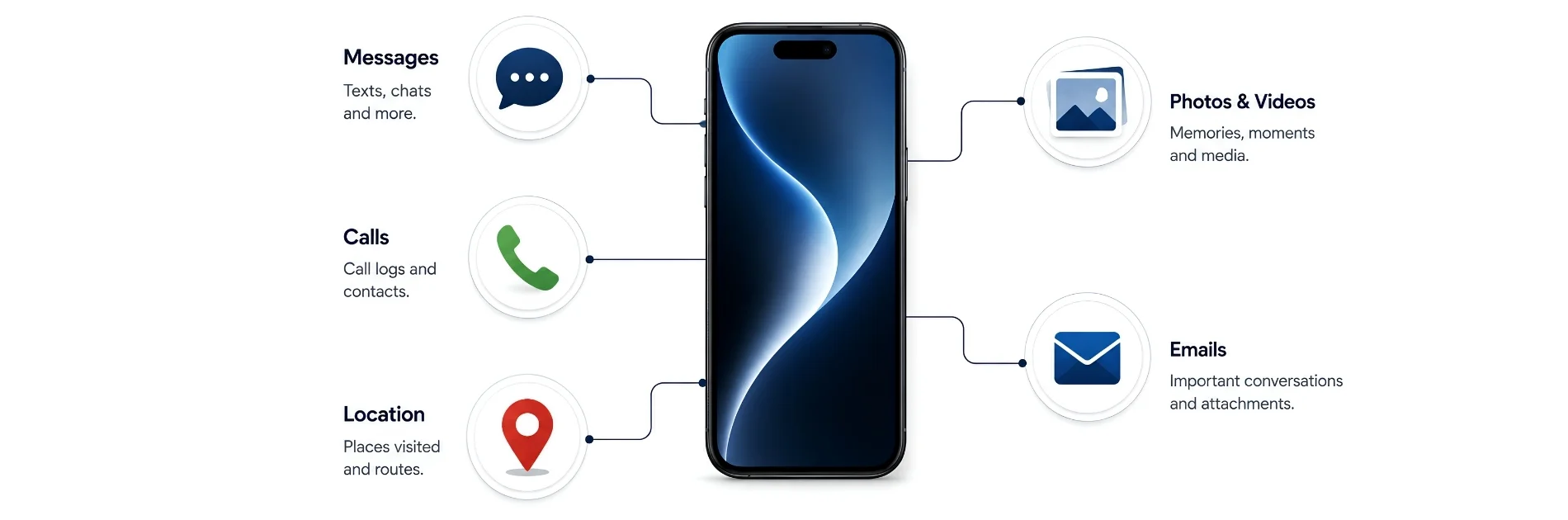
Consider what a smartphone holds onto:
- Calls made and received, timestamped to second.
- Text, chats, and voice notes among many apps.
- Photos with complete GPS information of where it was taken.
- Location that device passed through, whether app was open or not.
- Every email account synced to the device, including work inboxes.
Law enforcement research backs this up at scale. The FBI has noted that 90% of crimes investigated today contain some form of digital evidence, and mobile devices are at center of that figure. This is not niche data source. This is almost one for every person on Earth.
Here is part that matters for an investigation: laptop knows what happens when it’s open. Your smartphone never closes.
Eight Things Phone Can Tell an Investigator
Not every evidence inside a phone have equal weight. Here is what investigators look for, and why each one of these is important:
- Messages: SMS, iMessage, WhatsApp. These are most direct evidence of intent and planning.
- Calls: Call logs tell who, when and how long calls were made. This proves relationship existed even if the content is gone.
- Location history: GPS, Wi-Fi history and cell tower pings. Can place someone at scene more reliable than witness.
- Photos and videos: Every image has hidden EXIF data: exact time, exact GPS coordinates, even device model.
- Emails: Formal, timestamped and they are often most detailed written record of intent on entire device.
- Browser history: What someone searched when they were on a particular browser.
- App data: Health apps, ride-share history, food delivery, each one small, involuntary logbook.
- Deleted data: Often recoverable, and just as telling as what someone chose to keep.
On their own, each of these is puzzle piece. Together, they tell story no single piece could tell alone.
Related Read – MBOX File Format Basics
From Locked Phone to Courtroom-Ready Evidence
Knowing that evidence is in a phone is easy part. Getting it off, proving no-one tampered with it, and making it trustworthy is where the real work starts. This is digital forensics process, and it runs through four stages.
Extraction Ladder: How Investigators Pull Data Off a Phone
Here is an example that makes this instantly clear: Pulling data off a phone is like getting into a locked house. Sometimes you have key and you just walk in. Sometimes keys you have don’t work, so you go through a window. When nothing else works, you have to climb wall apart.
U.S. National Institute of Standards and Technology (NIST SP 800-101 Rev. 1) defines this as a six-level ladder, and good investigators always try least invasive option first.
| Level | Method | Explanation |
|---|---|---|
| 1 | Manual | Scrolling through phone by hand, like reading it over owner’s shoulder |
| 2 | Logical | Asking phone’s own operating system to hand over its files fast, but it shows what the phone wants to show. |
| 3 | File System | Pulling entire folder structure, including app data most tools don’t see. |
| 4 | Physical | Copying raw memory bit-for-bit, deleted files included it is “workhorse” level most real cases stop at. |
| 5 | JTAG / Chip-Off | Connecting directly to memory chip when the phone dont power on or unlock, it is the digital equivalent of removing wall panel. |
| 6 | Micro-Read | Reading individual memory cells under microscope, reserved for rare case where everything else has failed. |
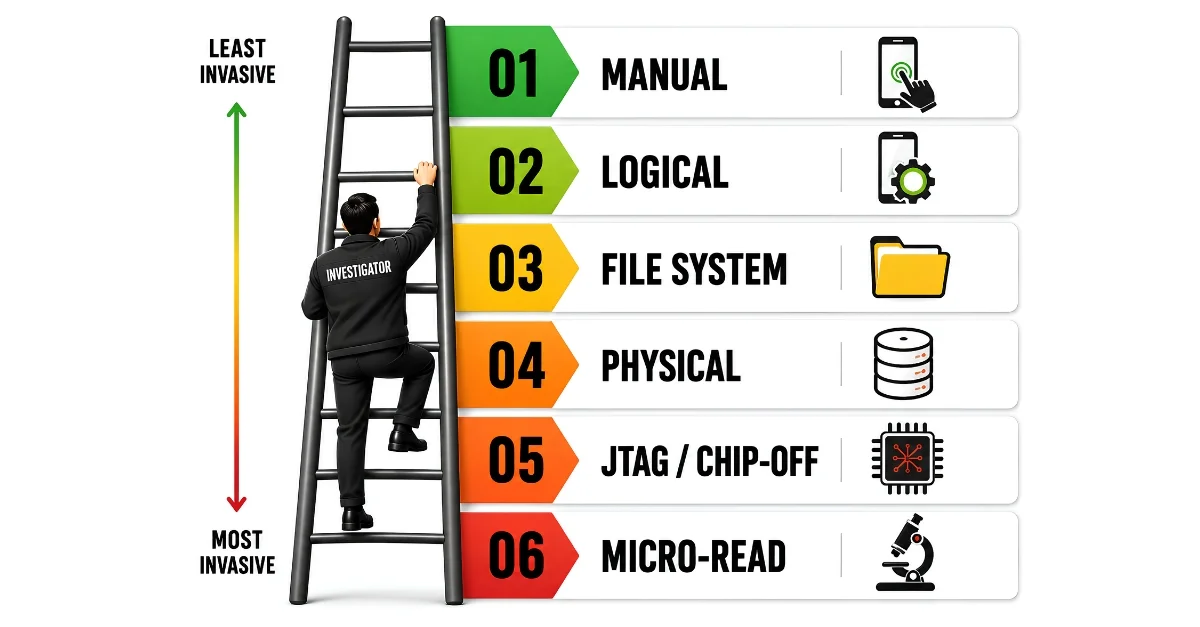
Most investigations never need to go post level 4. Knowing full ladder exists is exactly what separates a thorough digital forensic investigation from rushed one. We hope you are getting some clarity on why are mobile devices critical to a digital forensics investigation.
Why It’s Harder Than It Looks
Modern phones make this even more difficult. This is same security features that protect your data from thieves stand between investigators and truth.
- Encryption is vault door. Apple’s Secure Enclave, for example, is like a bank vault built inside a bank. Even removing entire memory chip will not open it without right key.
- Remote wipe is panic button. Phone connected to network can be wiped in seconds by someone who knows it has been seized. This is exactly why investigators isolate devices in signal-blocking Faraday bags the moment they are collected.
- Every phone (different UI and Operating Systems): iOS, Android, and manufacturer skins store data differently, so method that works on one phone can fail completely on the next.
- Suspects fight back. Anti-forensic apps and burner phones exist specifically to make this process harder.
None of this means that evidence is unreachable. It means it takes right process, right tools, and someone who knows exactly which rung of ladder to reach for. As mobile devices critical to a digital forensics investigation.
Does Mobile Evidence Hold Up in Court
Here is a question worth asking: none of this evidence means anything if a judge will not accept it. So how a raw data from phone become something courtroom trusts?
Answer is documented trail called the chain of custody. You as a reader can think of this like relay race baton. Every single person who touches that evidence, from officer at the scene to the forensic examiner in lab, has to record exactly:
- When they had it
- What they did with it.
- Who they handed it to next.
Drop baton once, unrecorded, and whole case can be challenged. This is best practice and it’s codified. ISO/IEC 27037 sets the international standard for how digital evidence should be identified, collected, and preserved.
In U.S. federal courts, Federal Rules of Evidence 901 and 902 govern how evidence gets authenticated in front of judge. Investigators also generate cryptographic hash values at every step, which is essentially a digital fingerprint that proves that not one bit of the data changed between seizure and courtroom.
Data Is Not Evidence Yet
Here is something worth saying: pulling data off a phone is not the same thing as understanding it. Single extraction can produce thousands of messages, images, and gigabytes of app data, all dumped in raw exports that look like unsorted filing cabinet the size of a warehouse.
Investigators who try to work through that by hand can lose days to a process that should take hours.
Raw data is not evidence. Organized, connected, timeline-mapped data is evidence. That gap is where most investigations either speed up or stall out.
Related Read – Outlook Email Forensic Analysis
Where Forensic Tools Fit In
This is a gap Freeviewer’s email examiner software, which also do mobile forensics is developed to close.
Once mobile data is extracted by tools like Cellebrite UFED, MSAB XRY, or Oxygen Forensic Detective, this tool lets investigators import that data directly and work on evidence specifically, without juggling separate tools to make sense of one mailbox.
Frequently Asked Questions
Q: Why mobile devices are considered the most valuable source of evidence in an investigation?
A – Because they combine more data types, messages, location, calls, photos, and email, into one continuously updated device than any other source investigators have access to.
Q: What’s the biggest challenge in mobile forensics right now ?
A – Encryption. Features like Apple’s Secure Enclave are built to keep data unreadable without the correct key, even if the memory chip is physically removed.
Q: Is data from a mobile phone actually admissible in court ?
A – Yes, provided it was collected under a proper chain of custody. Courts rely on standards like ISO/IEC 27037 and Federal Rules of Evidence 901/902 to decide whether that documentation holds up.